
Home | About Us | Mana Whenua
Mana Whenua
Te Aro Pā – A historical & cultural narrative.

Kaituhi: Holden Hohaia, Te Aro Pā.
From the early nineteenth century, Te Aro Pā occupied a pivotal place within the cultural and political landscape of Te Whanganui-a-Tara.
By 1820 the harbour and its environs were already characterised by layered customary interests, shaped through whakapapa, occupation, use of resources, and the maintenance of ahi kā rather than exclusive ownership in a European sense.
Te Aro Pā
A historical & cultural narrative
But this was also a period of major upheaval. Northern taua and subsequent heke from Kawhia and Taranaki altered existing balances of power throughout the southern North Island and beyond. From Te Amiowhenua to Tahutahu Ahi, Tatarāmoa, Nihoputa, Whirinui, Taranaki, Tama te Uaua, Paukena, and Hauhauā, these events profoundly changed the tangata whenua of Kāpiti, Te Upoko o Te Ika, Te Tauihu and Wharekauri forever.
Within this context, two hapū of Taranaki origin gradually established enduring occupation at Te Aro. Ngāti Haumia (of Taranaki iwi) and Ngāti Tūpaia (of Ngāti Ruanui) emerged as the principal holders of ahi kā at Te Aro Pā and the surrounding area. Their authority rested on sustained residence, cultivation, use of coastal and harbour resources, and the defence of place.
Historians note that customary rights during this period were often localised and that those who remained on the land and continued to use it consolidated their standing, while those who withdrew saw their interests diminish over time. This was clearly evident after Ngāti Mutunga’s departure for Wharekauri in 1835 and the gifting of their interests between Te Aro and Paekawakawa, to Haumia and Tūpaia.
By 1840 Te Aro Pā was a settled and functioning kāinga and pā, integrated into wider networks of kinship and exchange across the harbour. While Te Āti Awa leaders such as Te Puni and Te Wharepouri played prominent diplomatic roles in the region, customary tenure remained plural and contested, with different hapū exercising authority in different localities.
And so it was, in 1840, on the eve of the Treaty of Waitangi, that the ahi kā of Te Aro Pā and its environs was firmly held by Ngāti Haumia and Ngāti Tūpaia. Their occupation was continuous and lived, grounded in whakapapa and daily engagement with the whenua and moana. Although colonial processes soon eroded Māori control over the physical land of Te Aro, the identity of its people endures. The descendants of Te Aro continue to uphold the mana of the whenua today, grounded in hapūtanga and the enduring legacy of ahi kā.
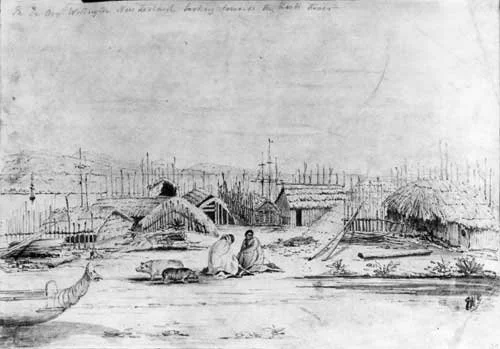
That legacy is now being reaffirmed in a modern context. Te Aro Pā Trust is responsible for managing the remaining lands still collectively owned by the descendants. The trust has some 1,500 members, all connected by whakapapa to the pā, and the current trustees (and a growing group of uri) are working to promote and maintain the ahi kā of this area.
So as descendants of Te Aro, while we have kinship ties to Te Āti Awa and the wider Taranaki Whānui collective, as well as Ngāti Toa, we are staunchly proud of our hapū identity: Ngāti Haumia ki Te Aro and Ngāti Tūpaia ki Te Aro. Our whakapapa connects us to place, and our place is Te Aro.
We are the descendants of Te Aro Pā.
What it means for us today
Te Tiriti o Waitangi – A Treaty-led facility
Mana whenua kawa and tīkanga are not overlaid onto an existing programme — they are foundational to how the building operates, how spaces are opened, and how the community is received.
Grounded in kawa and tīkanga
Toi Aro's relationship with mana whenua is one of active partnership. Decisions about the building, its programme, and its kaupapa are made in genuine relationship — not through one-off consultation processes.
Active partnership, not consultation
The building carries te reo Māori names in its spaces, its signage, and its communications. Te reo is used as a living language at Toi Aro — not as decoration but as an expression of the building's identity and its place in Te Whanganui-a-Tara.
Te reo Māori as a living language
Toi Māori — Māori art and creative practice — is not a strand of Toi Aro's programme. It is at the centre. The building's exhibitions, residencies, and public events reflect a genuine commitment to platforming toi Māori at the highest level.
Toi Māori at the centre
Ngā Taonga Tuku Iho – Cultural Narrative
Mana whenua narratives and commissioned artworks are woven throughout Toi Aro, expressing identity and the ongoing presence of tangata whenua. This space carries meaning. Mana whenua stories, woven through design and art, grounding everything that happens here. New images to come.
More to come
Further cultural narratives, artworks, and stories will be added as the mana whenua partnership continues to develop and grow.